
Fashion Apparel Market Insights Report Analyzing Demand Trends And Competitive Positioning
The Business Research Company’s Fashion Apparel Global Market Report 2026 – Market Size, Trends, And Forecast 2026-2035
Press Release Disclaimer: This is a press release distributed through the XPR Media network. It has not been independently verified by our newsroom.

The Business Research Company’s Fashion Apparel Global Market Report 2026 – Market Size, Trends, And Forecast 2026-2035
LONDON, GREATER LONDON , UNITED KINGDOM, October 27, 2026 /EINPresswire.com/ — The global fashion apparel sector is experiencing remarkable momentum, driven by a blend of rising incomes, shifting lifestyles, and rapid technological progress. As consumer preferences evolve and brands innovate to meet new demands, this market is set to undergo substantial growth and transformation in the coming years. Here’s an insightful overview of the current fashion apparel landscape, including market size, regional influences, key growth drivers, prominent categories, and leading players.
Fashion Apparel Market Value and Expansion Forecast Through 2030
The fashion apparel market is projected to surpass a valuation of $2,343 billion by 2030. Situated within the broader Paper, Plastics, Rubber, Wood, and Textile industry—which is expected to reach $10,811 billion by the same year—fashion apparel will represent close to 22% of the total sector’s worth. The market is anticipated to grow steadily at a compound annual growth rate (CAGR) of 6% until 2030, fueled by various economic and consumer trends.
Request A Free Sample Of The Fashion Apparel Market Report
https://thebusinessresearchcompany.com/sample_request?id=24967&type=smp&name=Fashion%20Apparel%20Market%20Report%202026&utm_source=EINPresswire&utm_medium=Paid&utm_campaign=Oct_PR
Asia-Pacific’s Dominance in Fashion Apparel Revenue Generation
Looking at regional performance, Asia-Pacific is poised to emerge as the largest contributor to the fashion apparel market, reaching an estimated $891 billion by 2030, up from $649 billion in 2025. Growing manufacturing hubs, integrated textile supply networks, and a youthful, fashion-savvy consumer base are key factors behind this expansion. The popularity of fast fashion and affordable brand options, alongside omnichannel retailing and competitive labor markets in countries like China, India, Bangladesh, Vietnam, and Southeast Asia, further support this robust growth.
The United States as a Leading Country Market in Fashion Apparel
In terms of individual countries, the USA is expected to lead the fashion apparel market with revenues hitting $567 billion by 2030, increasing from $426 billion in 2025 at a 6% CAGR. Demand drivers include a preference for premium and designer apparel, rising interest in custom-fit and inclusive sizing, growth in direct-to-consumer brands, subscription-based apparel services, and advancements in smart textiles and sustainable fashion innovations.
Access The Detailed Fashion Apparel Market Report Here
https://thebusinessresearchcompany.com/report/fashion-apparel-global-market-report?utm_source=EINPresswire&utm_medium=Paid&utm_campaign=Oct_PR
Primary Factors Accelerating Growth in the Fashion Apparel Industry
Rising disposable incomes worldwide are enabling consumers to spend more on clothing, moving beyond basic needs toward trendy, branded, and high-quality apparel. Social media influence, celebrity endorsements, and digital platforms also encourage frequent wardrobe updates, fuelling demand for luxury, designer, and bespoke fashion in both developed and emerging markets. This factor is projected to add around 1.7% annual growth to the market.
Shifts in consumer behavior and lifestyle preferences further support growth as shoppers seek versatile garments suitable for home working, fitness, travel, and social events. This has increased interest in comfortable, functional, and sustainable apparel options, in addition to personalized fashion experiences. The rise of digital shopping and accelerated product launch cycles contribute another estimated 1.7% annual growth.
Technological advancements in textiles and retail also play a crucial role by introducing high-performance, more sustainable fabrics and enabling faster manufacturing processes. Automation and AI-driven personalization, virtual try-ons, omnichannel retailing, and data analytics improve product offerings and inventory management, adding approximately 0.5% to yearly market growth.
Key Fashion Apparel Categories Driving Market Expansion
The market is segmented into seven main product groups: tops, bottoms, dresses, outerwear, activewear, footwear, and accessories. These categories collectively are expected to contribute over $553 billion in added value by 2030. Tops lead the pack with a projected growth of $158 billion, followed by bottoms at $101 billion and outerwear at $70 billion. Activewear, footwear, and accessories are also significant contributors, driven by trends such as digital fashion design, on-demand production, resale and rental models, smart textiles, and agile supply chains.
Tops Represent the Largest Segment in Fashion Apparel by 2030
By 2030, tops will be the largest segment within the fashion apparel market, accounting for 25% of the total value, or $592 billion. This segment benefits from demand for versatile everyday and office wear, seasonal collections, value fashion, innovative fabric blends, celebrity collaborations, and limited-edition launches, all of which keep pace with evolving consumer preferences.
Additional Fashion Apparel Market Segmentation
The market is further categorized by material types, including cotton, wool, silk, synthetic fabrics, and others. Price segmentation ranges from luxury and premium to mid-range and budget-friendly options. Distribution channels encompass online retail, traditional brick-and-mortar stores, department stores, and specialty outlets. End-users are segmented into men, women, and children.
Impact of Exclusive Online Retailers on the Fashion Apparel Market
The rise of exclusive online stores is reshaping how consumers engage with fashion apparel by enhancing the shopping experience, expanding digital reach, and boosting direct-to-consumer sales. An example is NIYARA India’s launch in October 2024 of a premium women’s fashion online store featuring dresses, gowns, shirts, and trousers. This platform improves access to high-quality fashion, broadens brand presence, and offers globally inspired collections.
Fragmentation and Market Share Among Fashion Apparel Leaders
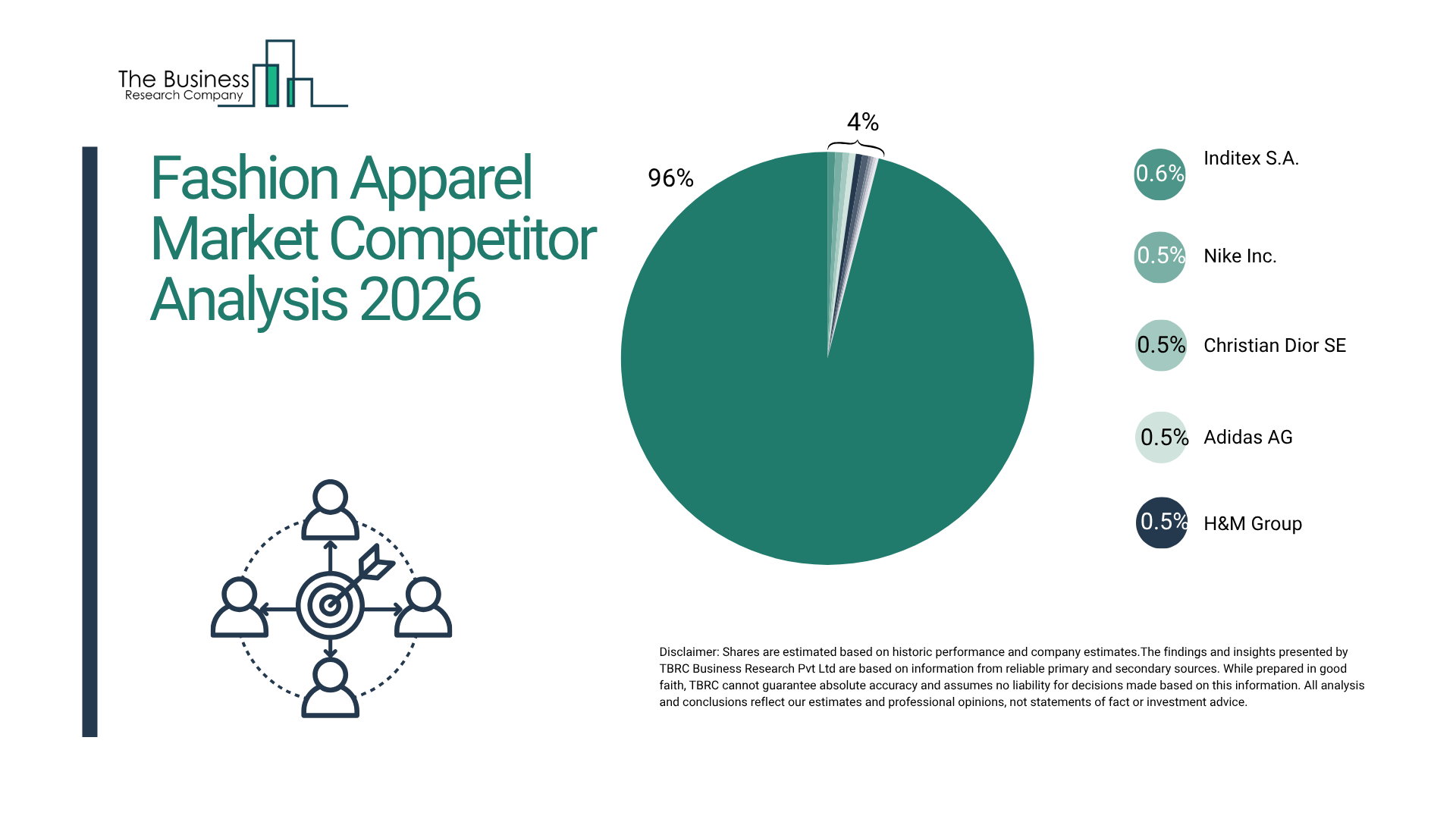
The fashion apparel market remains highly fragmented, with the top 10 companies controlling just 4% of total market revenue in 2025. This fragmentation stems from low barriers to entry, fast-evolving trends, and the need for brand differentiation, competitive pricing, and efficient supply chains. Leading firms maintain their positions through diversified portfolios, strong branding, global retail networks, and innovations in sustainable fashion and digital commerce. As consumer demand grows for trendy, personalized, and sustainable products, these companies are expected to strengthen their foothold through collaborations, innovation, and geographic expansion.
Top Companies Holding Market Shares in 2025
Among the leading players, Inditex S.A., Nike Inc., Christian Dior SE, and Adidas AG each hold about 1% of the market share. Other noteworthy companies include H&M Group (0.5%), Chanel S.A. (0.2%), Hermès International S.A. (0.2%), Richemont SA (0.2%), Shein Group Ltd. (0.2%), and PUMA SE (0.2%).
Competitive Strategies of Leading Fashion Brands
Top companies maintain competitive advantages by focusing on sustainable fashion practices, innovative apparel designs, expanding digital platforms, and employing advanced manufacturing technologies. These approaches enhance product differentiation, operational efficiency, and consumer engagement while supporting eco-friendly production and circularity.
Inditex S.A. Leading the Fashion Apparel Market with 1% Share
Inditex S.A. stood out as the top global apparel retailer in 2025, capturing a 1% market share. The company’s apparel division spans clothing, footwear, accessories, and fashion products that cater to diverse consumer tastes and global retail trends.
Major Names Steering the Global Fashion Apparel Market
Key companies active in the fashion apparel arena include Inditex S.A., Nike Inc., Christian Dior SE, Adidas AG, H&M Group, Chanel S.A., Hermès International S.A., Richemont SA, Shein Group Ltd., PUMA SE, Prada S.p.A., Levi Strauss & Co., Ralph Lauren Corporation, Moncler S.p.A., Next plc, LPP S.A., Burberry Group plc, Under Armour Inc., Lululemon Athletica Inc., and Boohoo Group plc.
Overview of the Fashion Apparel Market’s Value Chain
The value chain begins with raw material suppliers such as Lenzing AG, Indorama Ventures, Reliance Industries, Toray Industries, and others who provide essential fabrics and chemicals. Wholesalers and distributors include companies like Li & Fung Limited, Tapestry Inc., Apparel Group LLC, Global Brands Group, and Macy’s Merchandising Group, facilitating product flow. The end-user segment is represented by major brands and retailers such as Nike Inc., Adidas AG, Inditex S.A., H&M Group, Fast Retailing, Levi Strauss & Co., Ralph Lauren, Gap Inc., LVMH, Kering, Hermès, Burberry, Prada, Armani, Chanel, Uniqlo, Zara, Mango, American Eagle, Abercrombie & Fitch, Urban Outfitters, ASOS, Shein, and Forever 21, who bring products to consumers worldwide.
New analytical features added to our 2026 market reports:
• Market attractiveness scoring and analysis
• Total addressable market (TAM) analysis
• Company scoring matrix graphics and tables
• Excel-based forecasting dashboards
• Market hotspots infographics
• Key technologies and future trend analysis
• Updated graphics and tables
Learn More About The Business Research Company
The Business Research Company (www.thebusinessresearchcompany.com) is a leading market intelligence firm renowned for its expertise in company, market, and consumer research. We have published over 30,000+ reports across 27 industries and 60+ geographies. Our research is powered by 1,500,000 datasets, extensive secondary research, and exclusive insights from interviews with industry leaders.
We provide continuous and custom research services, offering a range of specialized packages tailored to your needs, including Market Entry Research Package, Competitor Tracking Package, Supplier & Distributor Package and much more.
Disclaimer: Please note that the findings, conclusions and recommendations that TBRC Business Research Pvt Ltd delivers are based on information gathered in good faith from both primary and secondary sources, whose accuracy we are not always in a position to guarantee. As such TBRC Business Research Pvt Ltd can accept no liability whatever for actions taken based on any information that may subsequently prove to be incorrect. Analysis and findings included in TBRC reports and presentations are our estimates, opinions and are not intended as statements of fact or investment guidance.
Contact Us:
The Business Research Company
Americas +1 310-496-7795
Europe +44 7882 955267
Asia & Others +44 7882 955267 & +91 8897263534
Email: marketing@tbrc.info
Follow Us On:
LinkedIn: https://in.linkedin.com/company/the-business-research-company.
Oliver Guirdham
The Business Research Company
+44 7882 955267
info@tbrc.info
Visit us on social media:
LinkedIn
Facebook
X
Legal Disclaimer:
EIN Presswire provides this news content “as is” without warranty of any kind. We do not accept any responsibility or liability
for the accuracy, content, images, videos, licenses, completeness, legality, or reliability of the information contained in this
article. If you have any complaints or copyright issues related to this article, kindly contact the author above.

Media gallery

