
Industry Report Shows 64% of Life Sciences Leaders Taking Action to Establish AI Governance
TORONTO and NEW YORK, Oct. 28, 2026
Press Release Disclaimer: This is a press release distributed through the XPR Media network. It has not been independently verified by our newsroom.

Industry Report Shows 64% of Life Sciences Leaders Taking Action to Establish AI Governance
PR Newswire
TORONTO and NEW YORK, Oct. 28, 2026
Research points to trust as the real barrier to scaling agentic AI, with 58% saying the industry still lacks clear standards for responsible AI
TORONTO and NEW YORK, Oct. 28, 2026 /PRNewswire/ — Life sciences organizations are putting governance in place to scale agentic AI across commercial, medical, and patient-facing work, according to the Responsible AI in Life Sciences (RAIL) Report 2026. The new industry research is based on roundtables and a survey of senior leaders at pharmaceutical, biotech, and medical device companies. Two-thirds (64%) surveyed say their organization has an AI governance process either fully established or in development.
The research, from ACTO, finds an industry ready to use AI but still working to trust it. Governance is the AI concern leaders cite most often. It is also the one they admit they have most neglected in practice. More than one-third still either have no defined governance or rely on a one-time IT approval.
Trust is the barrier to adoption at scale
The findings suggest trust will decide how far and how fast life sciences scales AI. Technology no longer appears to be the main obstacle. Leaders rank regulatory, legal, or compliance hesitation (21%) as the biggest internal barrier to scaling AI, while technical readiness ranks near the bottom (9%). Asked which measure matters most when judging an AI pilot, leaders put trust and adoption (24%) ahead of efficiency (23%), a signal that expectations are evolving.
Leaders trust AI more in their own hands than in their organizations’. More than two-thirds of leaders (68%) are involved in an AI project at their organization, and 69% rate their personal comfort with AI as high. But more than half (54%) remain concerned about how AI is being used in their own organizations. Fifty-eight percent say life sciences has no clear industry standard for responsible AI.
“The discussions reflected a wide range of perspectives and experiences related to AI understanding, adoption, and oversight across the industry,” said Lisa DeMarco, general counsel and chief business officer at Arctic Therapeutics and a moderator at the RAIL roundtables hosted by ACTO. “An important theme in the conversations was the need for practical guidance to help organizations assess AI trustworthiness while maintaining a focus on patient safety.”
Governance builds the foundation for trust
Leaders described governance as an ongoing operating model that continues well past initial approval. It needs named business owners, clear escalation paths, and standard operating procedures (SOPs), as well as the ability to deploy and revoke an AI agent and governance enforced at both the agent and sub-agent level. A challenge is that ownership is still unsettled. Asked who should be held ultimately accountable for the actions an AI agent takes, leaders name the end user (34%), legal and compliance (28%), the third-party AI vendor (22%), and IT (16%).
The data suggests responsibility falls to the end user because so much AI use happens outside approved systems. Nearly a quarter of organizations (23%) don’t monitor or discuss employee use of unauthorized AI agents, and roundtable leaders described employees already building their own agents with no governance in place. The gap between AI adoption and AI oversight is where trust seems to be breaking down across the industry.
Industry quickly moving from where to start to what to build next
Leaders want AI to raise performance and to be judged fairly. Four in five (79%) agree AI risk and ROI should be measured against how people do the work today, with its own error rate. Improved results and outcomes (29%) ranked as the top expected benefit, well ahead of budgetary savings (10%) and reduced risk (8%).
The leaders furthest along with AI sort each use case by its value and how hard it is to govern. Most start with easier-to-govern work such as review and approval cycles, pre-call preparation, insight logging, triage, and coaching. With two-thirds already running AI projects, attention is turning to harder work: connecting systems, supporting a full product launch, and chaining multiple agents together. An agent supporting a field rep or medical science liaison has to work across many systems and with the AI agents already built into each one. That raises new questions about what to trust and who answers for the result.
People remain the hardest part of adoption. The issue of change management was a common challenge raised at every roundtable. Asked which skill humans most need to keep, 45% chose judgment, followed by human connection (31%) and strategy (24%). The report recommends redrawing roles in detail, separating what an AI agent handles from what the human keeps.
Introducing a Common Standard for Trust: The RAIL Score
To give the industry a shared bar, the RAIL Score provides a rubric that grades any agentic AI system on six components of responsible AI, including governance, security, testing and certification, human centricity, value creation, and orchestration. Each component is scored “high” and trustworthy enough for use in life sciences, “medium” with specific gaps to close first, and “low” and not fit for use. The report also includes tools to put the score to work. These include a self-grading scorecard, a vendor-grading checklist, an AI agent job description template, and a 90-day launch checklist.
“The industry has moved past whether to use agentic AI. Leaders now want to know which systems they can trust enough to scale, and today there’s no shared bar to answer that,” said Parth Khanna, co-founder and CEO of ACTO. “Any agentic AI system has to get security and governance right. The RAIL Score gives teams a consistent way to grade systems against the standard a regulated industry demands, so trust can rest on evidence instead of vendor claims.”
Methodology
The Responsible AI in Life Sciences (RAIL) Report 2026 draws on eight in-person executive roundtables with 80 senior leaders across North America and Europe, held February through April 2026, as well as an online survey of 135 leaders at pharmaceutical, biotech, and medical device companies, fielded June 8 through July 17, 2026. Nearly all survey respondents (97%) hold director-level roles or above across commercial, medical affairs, legal and compliance, learning and development, and marketing functions.
The complimentary RAIL Report 2026 and related tools are available now at acto.com/RAIL.
To hear more about the findings, register for the upcoming webinar, “Responsible AI in Life Sciences: What Leaders Say About Scaling Agentic AI,” on Wednesday, November 4 at 11:00am Eastern.
About ACTO
ACTO helps life sciences companies bring therapies to patients after regulatory approval. Its AI-powered Field Excellence Platform and AI SuperAgents speed product launches, strengthen field execution, and deepen customer engagement for commercial and medical teams. ACTO elevates training and coaching and agentifies up to 30% of the work in customer-facing roles. That frees reps, medical science liaisons, and their leaders to focus on human connection, judgment, and strategic execution. Fourteen of the top 50 pharmaceutical companies use ACTO, along with high-growth biotechs and leading medtech organizations. ACTO is FDA 21 CFR Part 11 validated, SOC 2 Type II certified, and a Veeva Gold Product Partner. Learn more at www.acto.com.
Research Highlights
Responsible AI in Life Sciences (RAIL) Report 2026
The RAIL Report 2026 draws on eight executive roundtables with 80 senior leaders across North America and Europe and an online survey of 135 leaders at pharmaceutical, biotech, and medical device companies. Nearly all respondents (97%) are director level or above. The research examines how life sciences organizations evaluate, govern, and scale agentic AI in commercialization.
Governance Is the Defining Issue
- Nearly two-thirds (64%) say their organization has an AI governance process fully established (22%) or in development (42%).
- More than a third (36%) have no defined governance (21%) or rely on a one-time approval gate (15%).
- Governance was the most-cited AI concern across the roundtables, and leaders called it the most neglected in practice.
- Accountability is unsettled. Leaders are split on who owns an AI agent’s actions: the end user (34%), legal and compliance (28%), the AI vendor (22%), and IT (16%).
- Nearly a quarter (23%) don’t monitor or discuss employee use of unauthorized AI agents. Another 37% view it as a severe security violation.
Trust May Be the Real Barrier to Scale
- Over half (58%) say the life sciences industry lacks clear standards for responsible AI.
- More than half (54%) are concerned about how AI is used in their organization, even though 69% report high personal comfort with AI.
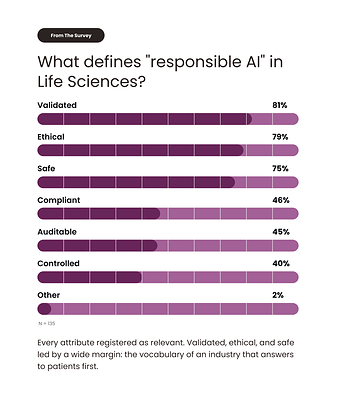
- Leaders define responsible AI as validated (81%), ethical (79%), and safe (75%). Fewer chose compliant (46%), auditable (45%), or controlled (40%).
- Four in five (79%) agree AI risk and ROI should be measured against today’s human-led baseline.
- Trust and adoption (24%) narrowly lead efficiency (23%), risk (21%), and ROI (18%) as the most critical measure of a pilot’s success.
From Where to Start to What to Build Next
- Two-thirds (68%) are already involved in an AI project at their organization.
- Start now (high value, easy to govern): review and approval cycles, pre-call prep, insight logging, triage, coaching.
- Build next (high value, harder to govern): connecting systems, supporting a full product launch, chaining multiple agents.
- Defer or constrain: anything that could reach a patient or regulator without a human in between.
- Improved results and outcomes (29%) lead efficiency (25%) and productivity (24%) as the most important expected benefit. Budgetary savings (10%) rank far lower, and reduced risk ranks last among the listed benefits (8%).
Barriers Are Organizational
- The top barriers to scaling are regulatory, legal, or compliance hesitation (21%) and a lack of comparative ROI metrics (20%). Technical readiness ranks near the bottom (9%).
- Leaders named three pressures driving AI adoption: more to commercialize, tighter budgets, and pressure to adopt AI even without a clear strategy.
- Workforce redesign is the real bottleneck to scaling. Leaders say judgment (45%), human connection (31%), and strategy (24%) are the skills humans most need to keep.
The RAIL Score
- The RAIL Score grades any agentic AI system on six components: Governance, Security, Testing & Certification, Human Centricity, Value Creation, and Orchestration.
- Each component is scored from 1 to 3, for a total out of 18: High (16–18), Medium (12–15), or Low (below 12).
- Security and Governance are hard floors. A score below 3 on either caps the system at Low.
The complimentary RAIL Report 2026 and related tools are available now at acto.com/RAIL.
To hear more about the findings, register for the upcoming webinar, “Responsible AI in Life Sciences: What Leaders Say About Scaling Agentic AI,” on Wednesday, November 4 at 11:00am Eastern.
 View original content to download multimedia:https://www.prnewswire.com/news-releases/industry-report-shows-64-of-life-sciences-leaders-taking-action-to-establish-ai-governance-302921619.html
SOURCE ACTO Technologies, Inc.



